
Soldier’s Paradise
Militarism in Africa After Empire
Duke University Press, 2024
A Foreign Affairs Best Book of 2025
Honorable Mention for the American Society for Legal History Peter Gonville Stein Book Award
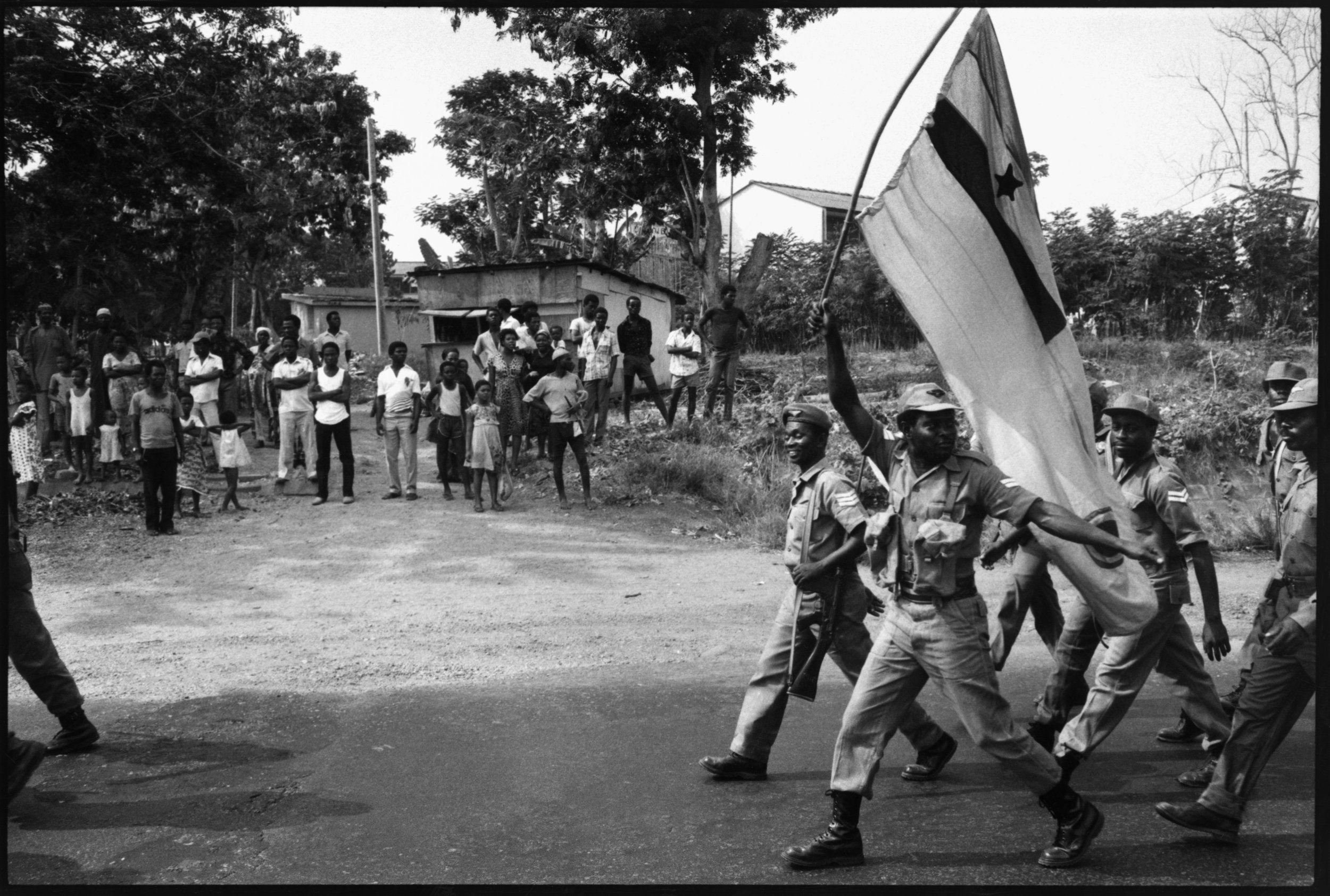
Soldier’s Paradise reconstructs one of the twentieth century’s most important and least understood ideologies–militarism. Across Africa, the late twentieth century was a time of military coups and martial “revolutions.” The men who staged them had utopian visions. In Nigeria and other former British colonies, army officers remade their countries along martial lines. Some soldiers tried to drum colonialism’s bad habits out of people through military-style discipline. Others conditioned civilians to think more like they did. A few believed that making their countries into vast open-air barracks was what would make them truly “free.” They saw judges and lawyers as allies in that mission, but law wasn’t the disciplinary tool they thought it was. Military regimes found that people could turn law back against them, and only some judges shared their world-making aspirations. Using an original collection of legal records, archival documents, and memoirs, Soldier’s Paradise shows how law facilitated militarism and, at times, worked against it. Long submerged by more hopeful ideological currents, militarism is resurfacing in African politics. Soldier’s Paradise describes where it came from.
Reviews
“Samuel Fury Childs Daly’s keen eye and steady hand push aside the conventional wisdom about military coups in Africa to show how military rule relied on courts to enforce the discipline that soldiers believed Nigeria needed. The rule of law and the rule of guns were not always an easy fit, but the space between them allowed for debate and dissent, most powerfully in the (literal) show trial of Fela Kuti.”―Luise White, author of Fighting and Writing: The Rhodesian Army at War and Postwar
“Samuel Fury Childs Daly makes a significant, although in some ways counterintuitive, argument that places law and legalism at the heart of studies of military rule and postcolonial transitions in Africa. While Daly recognizes that military regimes are marked by indiscriminate arrests and violence, control over judiciaries, and the crude abuse of legal processes, he shows that law and legality are central to military self-fashioning, identity, and practice, and therefore they are key to how these regimes are formed. This innovative and exciting work of legal history will speak to wide audiences.”―Rohit De, author of A People’s Constitution: The Everyday Life of Law in the Indian Republic
"In this provocative book, Daly argues that militarism in Africa has historically been about more than power grabs. . . . This important insight, which applies to coups past and present, goes against the standard view of coups as simply extraconstitutional and undemocratic events. Daly makes an important contribution, and in many ways a correction, to our understanding of what has motivated African civilian and military rulers alike."―Ken Opalo, Foreign Affairs
"A self-proclaimed provocation rarely lives up to its billing, at least in North American academic circles. This book is an eloquent exception to this rule. . . . Soldier’s Paradise is a vital and deeply challenging work that deserves a very wide audience."―Jeremy Rich, African Studies Quarterly
"A brilliant, unique, and unforgettable account of militarism in Africa. . . . Given the stakes of this reading for contemporary conversations around decolonization, Soldier’s Paradise successfully provokes in the reader an angst that is certain to linger."―Rabiat Akande, Journal of Law and Social Inquiry
"The brilliance of this book lies less in its analysis of violence than of law. Whereas violence creates the basis of power, customary and martial law forms the basis of politics. Power and politics are, therefore, united by law. . . . Highly recommended. Advanced undergraduates through faculty."―T. O. Falola, Choice
“Daly offers a rich account of military rule as a system born of the particular characteristics of the military as an institution. . . . As military rule once again sweeps across West Africa, Soldier’s Paradise is a valuable provocation to take seriously the ideology that motivates today’s military leaders.”―Danny Hoffman, International Journal of African Historical Studies
“Soldier’s Paradise did not disappoint. I found it to be smart, well researched, and highly enjoyable to read. . . . A timely and important book.”―Alicia C. Decker, African Studies Review
"This beautifully written and revealing book represents a refreshing look at Africa’s military regimes, placing them within the context of legal history."―Tim Stapleton, Canadian Journal of African Studies
"Soldier’s Paradise constitutes a good work of art as the author writes confidently and beautifully, given his ample knowledge of the subject matter. . . . Daly successfully flips the script on the military in politics across the continent."―Kwaku Nti, Journal of Global South Studies